Through the Digital Door: Winter Works and Christmas Carols 2025

This feature is adapted from CMC Scholar-in-Residence Laura Sheils’ public talk ‘Winter and Festive Highlights’ that was presented in the CMC Creative Space in November 2025.
Find out about Laura’s activities as Scholar in Residence by following @CMCIreland on social media or signing up to the CMC newsletter.
As we approach the festive season, it is the perfect time to delve into some of the Christmas and winter-themed choral works in CMC’s catalogue. Contemporary composers both here and overseas have continued the trend of composing new Christmas pieces based on Medieval texts, many of which combine old and new musical techniques to capture the jubilant season.
Eoin Mulvany (b. 1978): Is Úar Geimred (2013)
Eoin Mulvany’s Is Úar Geimred sets two ancient poems in the Irish language – Scél lem dúib and Is Úar Geimred – about Fionn MacCumhaill, the leader of the Fianna in Irish folklore. ‘Scél lem dúib’ translates as ‘This is my story’, and unfolds as a description of the coming of winter, as the stag bellows, the snow falls, the sun descends, and the high, cold winds bring the season of ice. Mulvany’s piece was premiered by the Mornington Singers, conducted by Orla Flanagan, in Dublin in 2014, and features on their album Under-Song (2017).
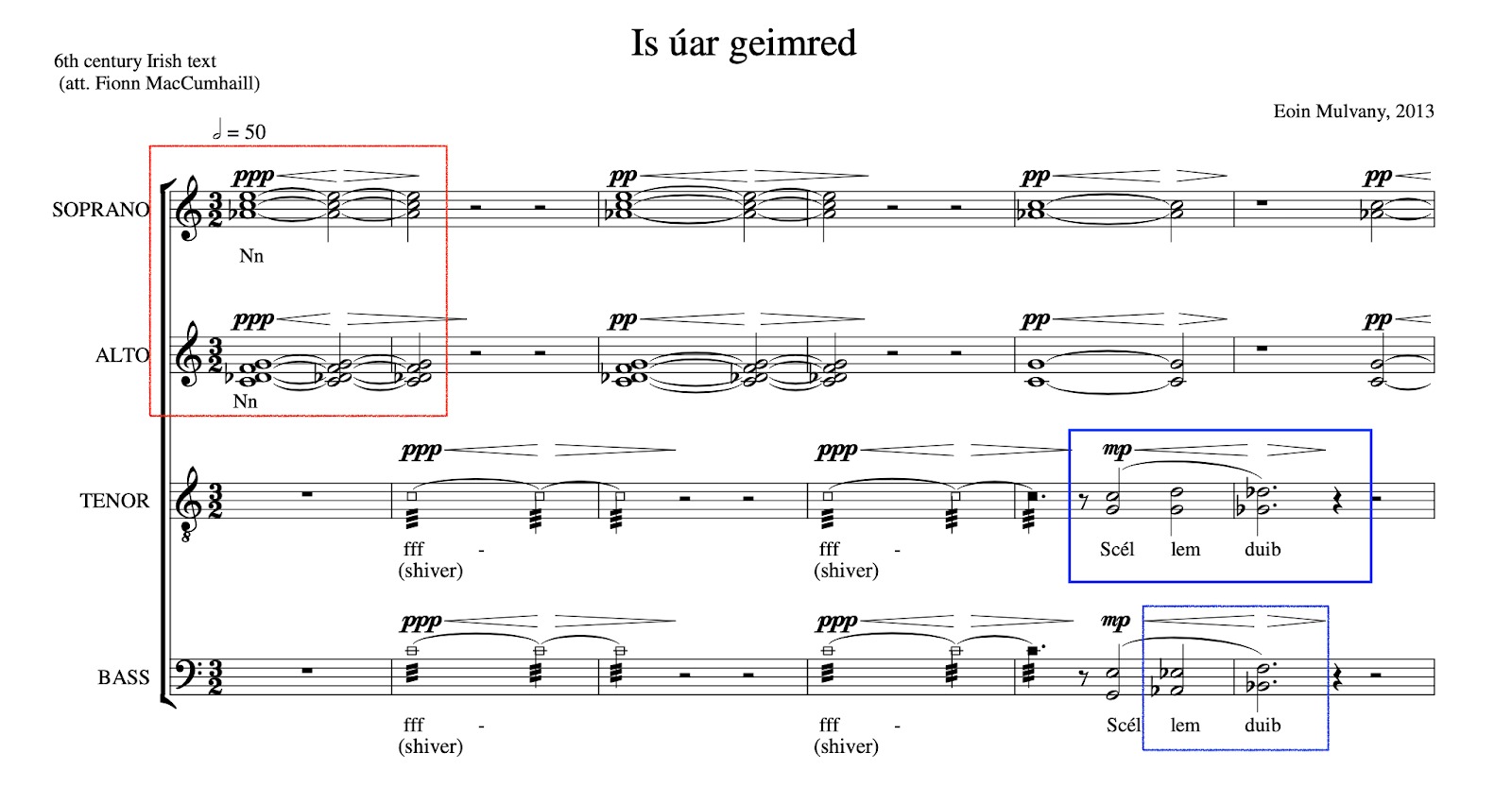
Image credit: Eoin Mulvany – Is Úar Geimred (2013).
Mulvany combines cluster chords and parallel open fourths and fifths in the introduction and conclusion to create a mysterious tone, bringing the ancient story to a contemporary audience. The unpitched ‘fff’ lower vocals emulate the shivering in the cold, giving way to a repetitive percussive motif, ‘bm pr-r-r dt dt ta’, which is intended to emulate the sound of a bodhrán. It could also be interpreted as the stag’s movement through the wood, as described in the poem, further narrating the ancient Irish text. The texture and melodic activity progress in a lively, rhythmic manner, with the various motifs – primarily the oscillating melodies and percussive idea – repeated, developed, and juxtaposed, across the piece. Is Úar Geimred is a compelling, narrative choral piece that captures the chill of the winter season, the galloping stag, and the sense of a past era in ancient Ireland.
Listen to the Mornington Singers perform Is Úar Geimred here.
Rhona Clarke (b. 1958): Make We Merry (2014)
Rhona Clarke’s Make We Merry is a setting of a fifteenth-century English text that ushers in the festive season: ‘Make we merry, both more and less, for now is the time of Christmas.’ Premiered by Chamber Choir Ireland, conducted by Paul Hiller in Christ Church Cathedral in 2014, this piece was later recorded by New Dublin Voices for their Christmas album Make We Merry (2017), and also features on State Choir LATVIJA’s album of choral works by Clarke, Sempiternam (2022). This piece forms part of Clarke’s set of Three Carols on Medieval Texts.
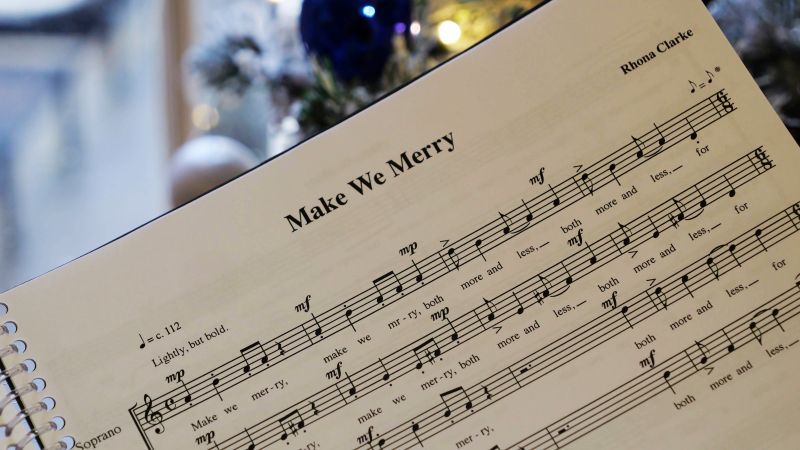
Listen to State Choir LATVIJA perform Make We Merry here.
Eoghan Desmond (b. 1989): A Babe is Born (2017)
Premiered by Chamber Choir Ireland in 2017, Eoghan Desmond’s A Babe is Born captures the exuberant spirit of the medieval macaronic text through a synthesis of ancient and contemporary musical techniques. The original fifteenth-century carol, found in the Sloane Manuscript, contains five English verses presenting a rapid summary of the Nativity, with each verse ending with a Latin exclamation of praise. Desmond’s carol forms part of his 4 Medieval Carols (2014–2017), all of which set and arrange familiar carol texts.
 Image credit: Eoghan Desmond, A Babe is Born (2017).
Listen to Chamber Choir Ireland perform A Babe is Born here.
Seán Doherty (b. 1987): A Nywe Werk (2014)
Winner of the Choir & Organ Magazine International Composition Competition in 2014, Seán Doherty’s A Nywe Werk for mixed choir has been performed extensively in concerts and at international choral competitions in Ireland and abroad. The piece was premiered by Merton College Choir, Oxford, as part of the college’s 750th anniversary celebrations in 2014, and has been recorded by New Dublin Voices for their album Make We Merry (2017). The composer sets a fifteenth-century carol from the Seldon Manuscript, ‘A nywe werk is come on honed’ (‘A new work is come on hand’), which celebrates the birth of Jesus Christ.

Doherty applies both ancient and modern musical techniques throughout the work, acknowledging the medieval origins of the text while ensuring the music speaks to today’s audience. The changing time signatures, cross-rhythms, lively tempo, open harmonies, and controlled expansion of texture results in an energetic piece that encapsulates the joy of the festive season. Doherty alludes to the original medieval carol in his melody, paying homage to its origins. The conclusion of A Nywe Werk features a triumphant polyphonic outburst of ‘Alleluias’ in the upper voices, flurrying above the tenors and basses’ homophonic expression of text – ‘God sende us lyf that lasteth longe! Now joye and blyss be hem among, that thus cunne synge’, the dynamics gradually building to fortissimo through the final ‘Alleluia’ refrain.
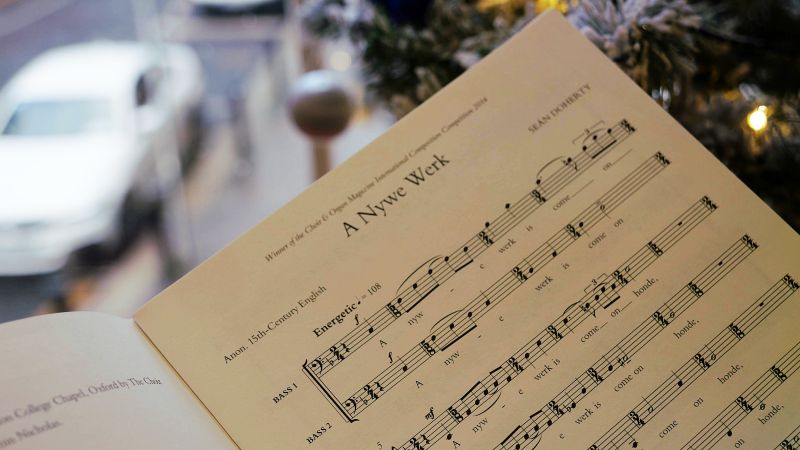
Listen to New Dublin Voices’ recording of A Nywe Werk here.